Whatsapp
If your production line depends on repeatable temperatures—think injection molding, laser equipment, printing, food processing, medical devices, or any heat-sensitive process—temperature drift can quietly become your most expensive “invisible” problem. A Cooled Chiller is designed to remove heat from your process and keep coolant temperature within a controlled range, so your equipment runs consistently, your product quality stays steady, and unexpected downtime becomes less frequent. This guide breaks down how to choose, size, install, and maintain a Cooled Chiller in a practical, plain-language way, with checklists, comparison tables, and troubleshooting tips that help you avoid the common pitfalls buyers regret later.
Most buyers don’t wake up thinking, “I need a Cooled Chiller.” They show up because something hurts: scrap rates rise, a machine trips unexpectedly, cycle times stretch, or product dimensions drift just enough to cause rework. A well-chosen Cooled Chiller addresses these pain points by stabilizing the heat balance in your process.
The goal isn’t “the coldest water possible.” The goal is the right temperature, consistently, with a flow rate and pressure your equipment can rely on. That’s where a properly sized, properly installed Cooled Chiller pays for itself.
Think of your process as a heat generator. Motors, lasers, molds, hydraulic systems, and compressors all create heat. A Cooled Chiller pulls that heat away using a circulating coolant loop and then releases the heat to the environment.
In simple terms, there are two “loops” you should understand:
Inside the chiller, the refrigeration circuit does the heavy lifting: it compresses refrigerant, rejects heat at the condenser, expands through a valve, and absorbs heat at the evaporator. Your process coolant passes over the evaporator and gets cooled back down to the setpoint.
The “smart” part is control: sensors, controllers, and safety protections keep temperature stable and prevent damage when flow drops, filters clog, ambient temperature spikes, or a pump behaves badly.
Not all Cooled Chiller designs behave the same in the real world. Your best option depends on space, ambient conditions, heat load size, and how sensitive your process is to temperature drift.
| Type | Best For | Pros | Watch Outs |
|---|---|---|---|
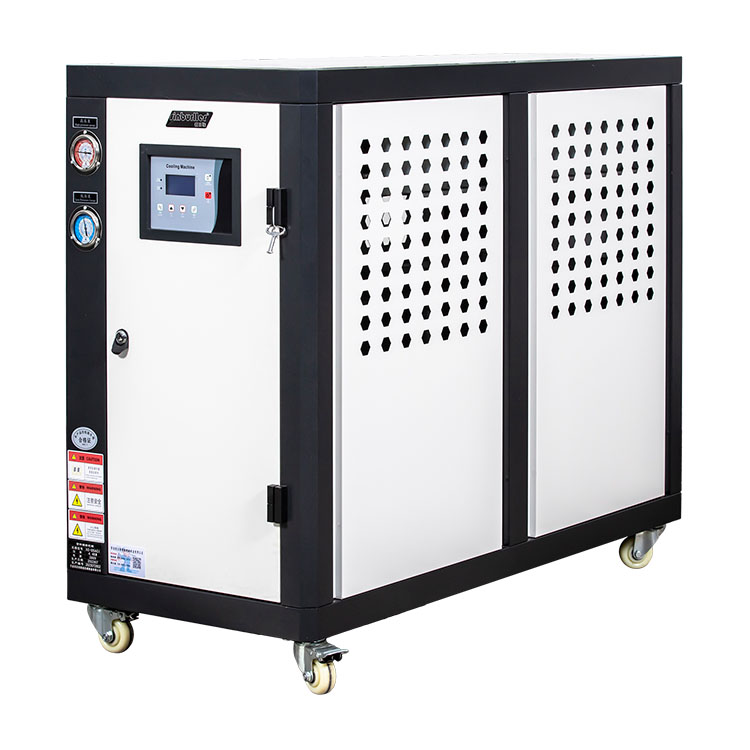
| Air-Cooled Chiller | Small–medium loads, quick installs, limited infrastructure | No cooling tower; simpler piping; easier relocation | Performance depends on ambient air; needs ventilation space; can be noisier |
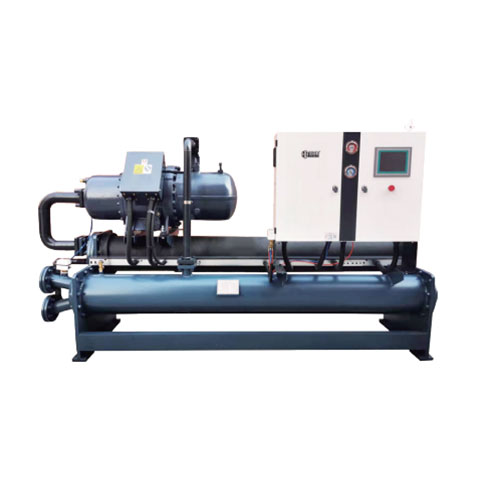
| Water-Cooled Chiller | Medium–large loads, hot climates, facilities with towers/loops | Often higher efficiency; steadier heat rejection | Requires cooling water system; water quality management matters a lot |
| Screw Chiller | Larger, continuous loads; long operation hours | Strong for stable, high-capacity cooling; suited to continuous duty | Sizing and control strategy matter; installation quality impacts results |
If your plant is new or you want a straightforward setup, an air-cooled Cooled Chiller is often the fastest route. If your heat load is big, ambient temperatures are high, or you run long hours, water-cooled or screw systems may deliver a better long-term cost profile.
Buyers sometimes focus on a single headline number and miss what makes a Cooled Chiller succeed in daily operation. Here’s what you should prioritize when comparing options.
A quick buyer’s checklist:
| Question | Why It Matters | What to Ask For |
|---|---|---|
| What is my peak heat load? | Avoids undersizing and constant overload | Heat load estimate method and safety margin |
| What’s my required setpoint range? | Some processes need tighter control than others | Stability performance under load changes |
| Do I have space and airflow for heat rejection? | Poor airflow kills air-cooled performance | Ventilation guidance and clearance requirements |
| How will I keep water clean? | Scaling/corrosion reduces capacity and causes failures | Filtration plan, water treatment recommendations |
A good rule of thumb: if a spec doesn’t help you predict stability, reliability, or operating cost, it’s probably not the spec you should obsess over.
Even the best Cooled Chiller can look “bad” if installation is sloppy. Most performance complaints trace back to basics: incorrect piping, insufficient flow, trapped air, dirty water, or poor ventilation.
After installation, run a simple commissioning routine: verify setpoint control, record stable temperatures at multiple loads, and document “normal” pressures/flow so your team can spot issues early.
If you’re buying a Cooled Chiller, you’re buying electricity for years. The trick is to reduce waste without risking temperature drift. These improvements are usually high-impact and low-drama.
Efficiency isn’t only a machine spec. It’s a system outcome: correct sizing, clean heat transfer surfaces, stable flow, and sensible setpoints.
A Cooled Chiller that’s easy to maintain tends to get maintained. And the chiller that gets maintained is the one that stays stable year-round. Below is a practical guide your operators can actually use.
Routine maintenance (simple schedule):
Common symptoms and first actions:
| Symptom | Likely Cause | First Action |
|---|---|---|
| Coolant temperature won’t reach setpoint | Dirty condenser/heat exchanger, insufficient airflow, high ambient, undersized capacity | Clean heat transfer surfaces; verify ventilation; confirm load isn’t higher than expected |
| Frequent alarms or shutdowns | Low flow, clogged filter, pump issues, unstable power | Check flow indicator; clean filters/strainers; verify pump and electrical supply |
| Temperature swings during production | Load changes, air in loop, poor control tuning, inconsistent flow | Purge air; stabilize flow; review control settings; confirm sensors are positioned correctly |
| Pump noise or cavitation | Air ingestion, low coolant level, restriction on suction side | Check tank level; bleed air; inspect piping and valve positions |
If you want long-term stability, treat coolant quality like a core utility—because it is. Clean water and clean heat transfer surfaces are “capacity.”
A Cooled Chiller is not only for one industry. It’s a reliability tool whenever heat threatens quality or uptime. The best results come from matching the chiller strategy to the process behavior.
If you’re evaluating suppliers, it’s worth choosing a partner who can discuss your application details—heat load patterns, duty cycle, ambient conditions, coolant type, and future expansion—not just sell a generic unit. Many buyers prefer working with manufacturers like Ningbo Xinbaile Intelligent Machinery Manufacturing Co., Ltd. because a process-focused discussion often prevents expensive mis-sizing and rework.
A Cooled Chiller is one of those pieces of equipment that quietly decides whether your line feels “stable” or “fragile.” If you want help selecting the right configuration—air-cooled, water-cooled, or higher-capacity solutions—share your application basics (heat load, setpoint, ambient conditions, and run hours), and the selection becomes much clearer.
Ready to turn temperature problems into predictable production? Contact us to discuss your process requirements and get a tailored Cooled Chiller recommendation from Ningbo Xinbaile Intelligent Machinery Manufacturing Co., Ltd.